Structures for Pedagogical Reflection
Explanation
Opening up space to be critically reflective of pedagogical practice and intentionally creating opportunities for teachers to pause, examine, and make sense of their teaching and learning practices.
Theory
By engaging in structured reflection, teachers develop greater awareness of how their decisions, facilitation, and classroom interactions influence student learning (Gerard et al., 2011; Sisk-Hilton, 2009). Inviting teachers to draw, share their drawings, or write reflections on their drawings, as these artifacts provide an excellent forum for critical reflection (Weber & Mitchell, 1996), which we know is essential to professional practice. This process can reveal the subtleties and uncertainties in individuals’ perceptions of teaching, as well as the cultural, social, historical, and personal biases that shape their understanding of teacher education.
Examples
During the values activity, Anita first selected five key values for her as a teacher: Problem Solving, Critical Thinking, Discipline, Positive Attitude, and Inclusivity. When asked to visually represent the relationships among these values, she placed Problem Solving at the center and connected the other four values with outward-pointing arrows. In a subsequent iteration, when teachers were asked to depict the values of their making space, Anita chose a flower as a metaphor (Figure 18). Each petal represented a value like Creativity, Cooperation, Equity, Community, and Multimodality, which were linked to learning. This iterative process illustrates how teachers can externalize and refine their understanding of values in relation to their evolving pedagogies.
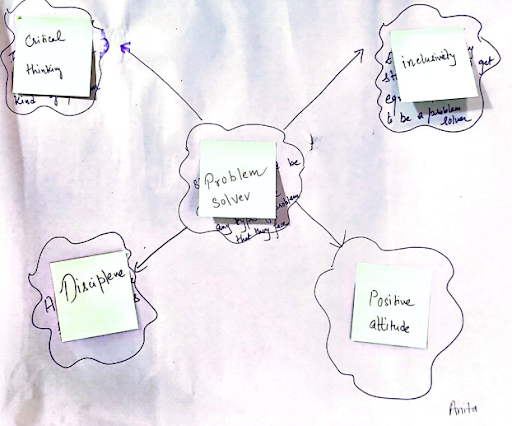
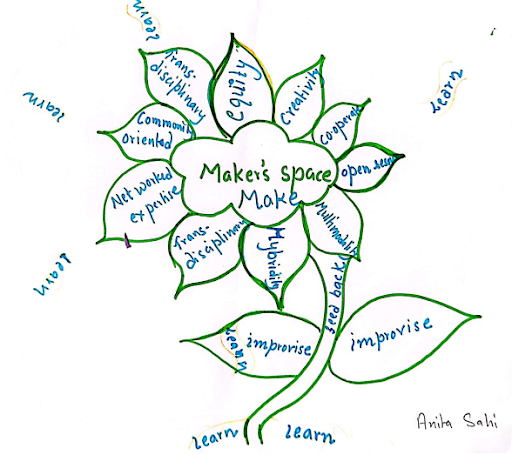
Figure 18: Anita’s evolving drawings of key values
After each classroom observation, we provided feedback using the What Went Well (WWW)/Even Better If (EBI) structure, helping teachers identify strengths and areas for improvement. In addition to these peer-feedback structures, teachers also began reflecting more deeply on their own pedagogical shifts. Tilak shared that earlier, a “good class” was defined as one where the teacher was comfortable and students sat quietly, but now he recognized that silence often signals a lack of interaction and limited learning (lines 54-57). Similarly, participating as a “student” in our sessions prompted him to reconsider the nature of homework: if assignments required effort but did not clearly contribute to knowledge, skills, or attitudes, then their value was questionable (lines 59-64). These realizations, supported by structured opportunities for feedback and reflection, highlight how teachers gradually reframed their assumptions about effective teaching and learning.
Implications
We need to intentionally design spaces for structured reflection within professional learning. Across the five phases, structured reflections using WWW/EBI framework and through iterative drawings, supported teachers in noticing and articulating their own pedagogical shifts.