Explanation
Using curiosity, experimentation, joy, and hands-on exploration to foster meaningful learning.
Connections to Theory
Play has long been recognized as an essential component of how young people make sense of their worlds, providing opportunities for risk-taking, exploring new configurations, and taking on new roles (Parker et al., 2022; Zosh et al., 2018).
Examples
Community teachers at Gulmi were invited to build an animal from a pile of LEGO blocks that were spread over a table-top. Although many were using LEGO for the first time and were initially hesitant, they slowly began creating lions, giraffes, dogs, and peacocks. The playful challenge sparked creativity and eased participants into an open, imaginative mindset for the session.
Teachers made a Thaumatrope, a simple 2-frame animation technique made using pencil and paper. Anu created two drawings: a fish and a bowl, that formed the illusion of a fish swimming inside the bowl when the stick was spun (Figure 17). The activity was inherently playful because it invited the participants to draw a fun two-frame animation to tell a story.
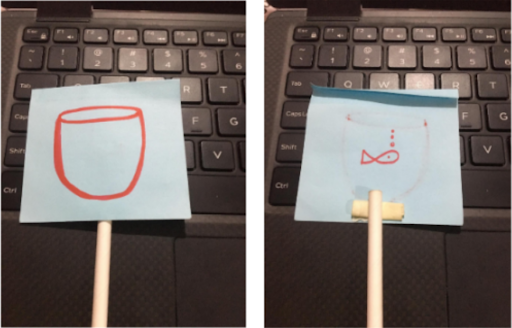
Figure 17: Anu’s Thaumatrope
Implications
For teachers, embracing playfulness means designing learning experiences that invite exploration, iteration, and creative problem-solving rather than compliance with fixed procedures. When educators experience playful learning themselves, they begin to recognize how curiosity, resilience, and collaboration can be cultivated through hands-on, open-ended activities. Embedding playfulness within professional learning not only makes sessions more engaging, but also models alternative pedagogical possibilities, encouraging teachers to reimagine their classrooms as spaces where meaningful and joyful learning can occur.