Providing platforms for teachers to showcase ideas, document progress, and receive public acknowledgment reinforce teachers’ identities as innovative educators and highlight the impact of their work within and beyond their schools.
Theory
Recognizing and celebrating teachers’ efforts is essential for strengthening motivation, validating their hard work, and fostering a culture where sustained effort is seen, shared, and valued. PLC design should treat recognition and celebration of teachers’ efforts as a central design feature rather than an add-on (Meesuk et al., 2021).
Examples
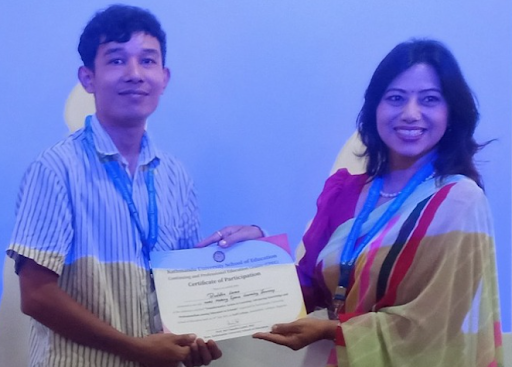
We recommended two teachers to present their work at a Teachers’ Conference organized by Kathmandu University (Figure 23). Buddha showcased how he engages students in his making space, while Anita shared the process of developing their school values and involving students in creating a physical installation to showcase the values. Both presentations were well received, and many educators expressed interest in their approaches, with several planning visits to learn from their experiences firsthand.
Figure 23: Buddha and Anita presenting their work at a Teachers’ Conference
Similarly, we made a conscious effort to highlight teacher impact at community events. During the Phase II closing event, we hosted a poster session where teachers showcased how they transformed their classrooms using playful learning (Figure 24). Shree highlighted students’ newfound confidence as they applied playful learning beyond the classroom, winning municipal and district-level science competitions and motivating other teachers to adopt similar approaches. Buddha shared how he facilitated hands-on learning in low-resource schools, demonstrating that play and experimentation can thrive with minimal materials. Tilak reflected on his shift from teacher-centered instruction to fostering interaction, iteration, and curiosity, guiding students toward deeper learning. Sabina demonstrated how she turned her classroom into a “room of discoveries,” to teach scientific concepts like chromatography and light through hands-on experiments, designing her own lesson plans, and providing students space for free play and prototyping, which encouraged creativity and collaboration. The presenters engaged in conversations with fellow teachers and educators from other schools, fostering dialogue and inspiring positive change across diverse learning contexts.
Figure 24: Teachers sharing their posters at the PEBL closing event
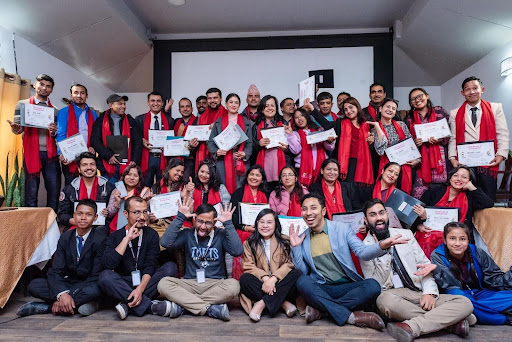
In each of the phases, we organized a graduation ceremony to recognize the efforts the teachers had put into implementing new ideas into their classrooms and to celebrate their dedication. In Phase III, two teachers delivered speeches sharing their experiences of integrating learning through play into their classrooms, reflecting on the challenges and successes they encountered. The ceremony concluded with a group photo of all participants proudly holding their completion certificates, creating a memorable and affirming moment that highlighted their commitment and growth (Figure 25).
Figure 25: Teachers being facilitated at the closing events
Implications
Creating structures to celebrate teacher engagement strengthens motivation, validates professional effort, and encourages continued innovation. When teachers feel seen and valued, they are more likely to share practices, collaborate with peers, and contribute to a broader learning community, fostering a supportive and interconnected professional culture.