
Phase III: Extending the Reach: Kheldai Sikdai Gulmi & Hetauda
Introduction (June 2023 – February 2024)
Kheldai Sikdai focused on working with teachers in Hetauda and Gulmi to help them deliver playful engineering-based learning experiences to their students using simple low-cost cost and easily accessible materials. Similar to PEBL, we aimed to build a community of practice focused on playful learning, and provided professional development sessions and learning toolkits in order to help the teachers bring hands-on learning to their students.
Learning Community
1. Hetauda: To recruit participants in Hetauda, we collaborated with the school leaders at Jana Priya School to select 7 public schools. Additionally, three low-cost private schools were added after conversations with the school leaders about the program and the required commitments.
2. Gumli: To recruit participants in Gulmi, we collaborated with United World School (UWS Nepal) which is a non-profit entity that is dedicated to providing free, accessible, quality education to children in the most remote and marginalized areas. In Nepal, UWS runs a fellowship program that places young people who have finished their undergraduate degree in different schools for a year, to support the school leaders and teachers. The learning community comprised 4 UWS Nepal fellows and 8 community teachers.
Stages
1. Identify new sites: To extend the reach of the resources we had developed in Phase II, we wanted to expand to two sites outside Kathmandu. The first site, Hetauda is 82 km away from Kathmandu and is the capital of Bagmati Province. The majority of the students attending public schools belonged to marginalized communities, with more female students in the cities attending public schools compared to private ones. The second site, Gumli is a rural district located in the hills of Lumbini Province which is 356 km far from Kathmandu. We collaborated with teachers from 8 public schools in Gulmi to help them deliver playful experiences to 570 students.
2. Adapt to local contexts: In Gulmi, teachers engaged with locally meaningful stories, materials, and practices to design learning experiences. In a Novel Engineering activity, the teachers identified relevant problems, such as poverty, and created tangible solutions using simple materials like paper, string, and toothpicks. Hands-on tasks, like building animals from LEGO, encouraged playful experimentation, sharing, and feedback once teachers were given time and support to explore unfamiliar materials. Material constraints prompted teachers to adapt standard kits by incorporating local resources such as leaves, bamboo, clay, and straw. The teachers also had to organize the kits in huge boxes and distribute them to different rural locations from the town center at Resunga municipality.
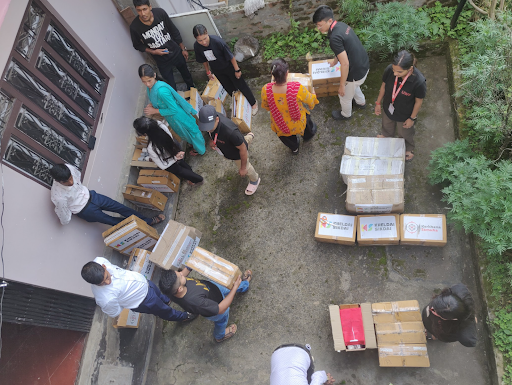
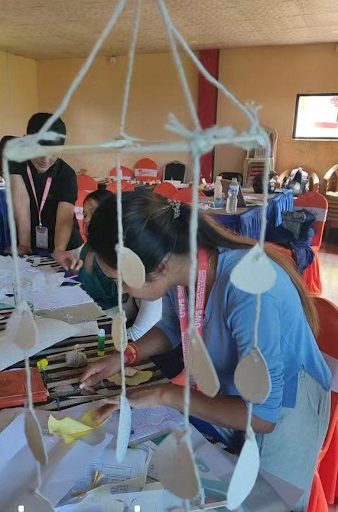
Figure A6: Teachers organizing learning kits for distribution to the rural sites and designing solutions using simple materials in a Novel Engineering activity.
Key Insights
1. Local leadership strengthens implementation: In Hetauda, partnering with local educators was critical to meaningful engagement. Hiring a local, Safalta, as a coordinator and community mobilizer enabled consistent classroom observations and timely feedback. With support from Yukta Lal Bishwakarma, whose extensive teaching experience and connections with local government ensured diverse school selection, the project was grounded in local knowledge, trust, and institutional alignment. This reinforced the importance of community-based leadership for sustained impact.
2. Flexible design overcomes distance: In Gulmi, geographical barriers required restructuring the delivery model. Rather than replicating the original format, we consolidated sessions into intensive in-person workshops during three site visits and supplemented them with monthly virtual check-ins. Facilitators also adapted materials to local contexts. For example, selecting the culturally relevant Nepali story Sanu and the Storm for the Novel Engineering session to strengthen linguistic accessibility and cultural resonance.
3. Virtual support sustains momentum: Monthly virtual catch-ups created continuity between in-person workshops, offering space to discuss pedagogical ideas and reflect on challenges using the toolkits.