
Explanation
This design element emphasizes the importance of designing environments where teachers can learn with and from each other. These spaces allow educators to exchange ideas, give and receive feedback, and collectively make sense of their experiences along with their evolving pedagogies.
Theory
Collaboration transforms reflection from an individual process into a shared one, where learning deepens through dialogue, observation, and co-construction of meaning (Tam, 2015). By intentionally structuring these spaces, educators can move beyond hierarchical classroom norms, where teachers hold privileged positions, and foster reciprocal peer learning that values multiple voices and experiences (Ochs, 1997).
Examples
Deepening teachers’ understanding of the five characteristics of Learning through Play (LtP) required careful scaffolding and structured peer dialogue. Rather than simply asking teachers to “identify play,” we first invited them to experience play themselves. In one workshop, teachers played a game together and reflected on the prompt: What makes play fun? Building on their responses, we introduced the five characteristics of LtP and watched a short video developed by LEGO Education to ground the framework in classroom examples. Teachers then practiced noticing the characteristics through a guided progression. Working in pairs, they analyzed three curated classroom videos and used a grid on Google Slides that aligned with the five characteristics (Figure 20). The prompt was specific: Add your ideas in the corresponding box when you notice an instance that fits the definition of a characteristic of play. The first video showed two students excitedly discovering how a periscope allows you to view objects from a higher or lower perspective without being in the line of sight; the second featured students building a scribbler bot and celebrating when the motor worked; the third showed students iterating designs to build the tallest book-supporting structure. Initially, teachers tended to make broad statements such as “students are engaged” or “they are iterating.” Through facilitated dialogue and repeated viewing, however, they were pushed to ground their interpretations in observable evidence by responding to questions like Who is engaged? What exactly shows iteration? What language indicates social interaction?
One area of consistent struggle was identifying the “meaningful” characteristics of play. Many teachers could easily recognize joy, active engagement, iteration, and social interaction when a motor worked or a structure stood tall. Meaningfulness, however, required deeper interpretation. It was only after collective discussion of the first two videos, probing students’ intentions, connections to prior knowledge, and ownership of ideas, that teachers began to articulate more nuanced examples. This iterative cycle of observing, documenting, discussing, and revising interpretations demonstrated that noticing play was not intuitive; it required structured prompts, multiple viewings, peer dialogue, and facilitation. Through this process, teachers gradually sharpened their analytic lens and developed a more evidence-based understanding of playful learning in practice.
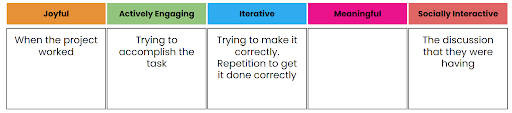
Figure 20: Anita’s noticings of playful characteristics when viewing the second video
During a virtual session based on Isabel Wilkerson’s book, Caste, the facilitator used a shared Google Document to engage participants collaboratively in exploring the book’s eight pillars of caste. Combined with small breakout rooms in Zoom, these tools created spaces for participants to discuss complex ideas and co-construct understanding. In one breakout room, Rupak shared a personal childhood experience of casteism, which resonated with others and sparked deeper reflection. These collaborative virtual spaces allowed teachers to learn from one another, clarify difficult concepts, and collectively deepen their understanding.
Implications
Structured spaces for collaborative reflection and peer learning allow teachers to share ideas, make their thinking visible, and learn from one another. Through storytelling, discussion, and multimodal representations, teachers can examine classroom decisions, experiment with new approaches, and integrate theory with practice. Participation in PLCs disrupts isolated, textbook-driven habits, fostering trust and collaboration.